
Make accessibility
effortless, in any space
Caption and translate live - in any space, on any screen, in any language.
One platform. Every voice.
Accessibility that works, wherever you do

Work. Subtitled
Use smart captioning technology to help your teams to communicate better, work smarter, and unlock their true potential.

Sports. Subtitled
Stream live commentary and announcements to your deaf and hard-of-hearing attendees so they never miss another moment.
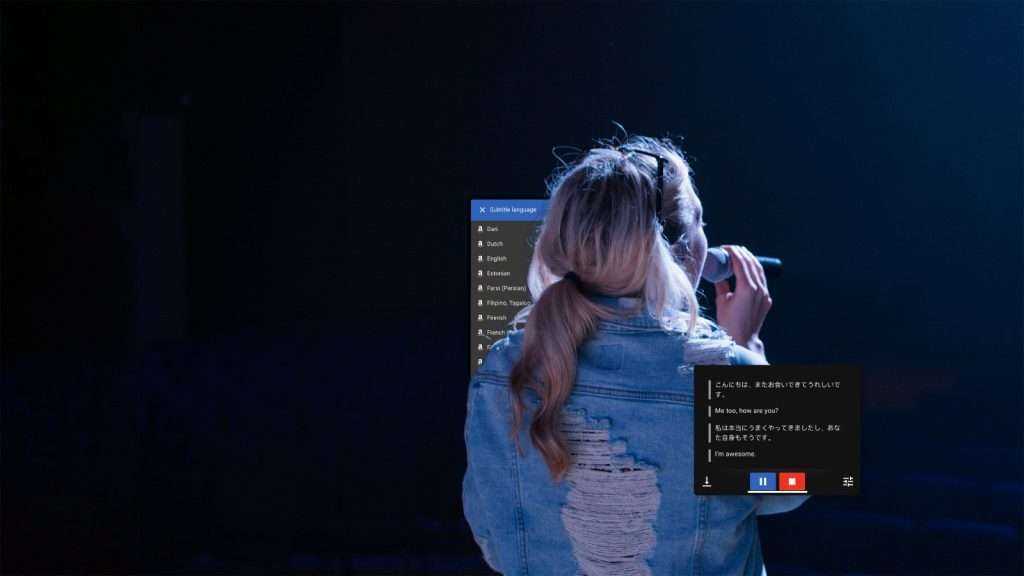
Events. Subtitled
Instantly caption, translate, and broadcast live events across multiple devices.

Theatres. Subtitled
Instantly caption, translate, and broadcast live performances across multiple pairs of smart glasses.
Frequently asked questions
What is live captioning?
Live captioning, also known as real-time captions, refer to the process of transcribing spoken words into written text during a live event. This immediate transcription facilitates greater accessibility as it assists those who are deaf, hard of hearing, or non-native speakers to comprehend the spoken content. The main goal of live captioning is to foster inclusive communication by breaking down language barriers.
How do the glasses work?
Closed captioning glasses are state-of-the-art devices that visually present real-time captions directly to the wearer’s field of vision. They integrate technology such as Augmented Reality (AR) to relay textual dialogues, offering a personalized viewing experience for individuals with hearing difficulties.
This technological evolution fuels inclusion, and enables the wearer to enjoy outdoor performances, movies, and many other events without disrupting the viewing experience of others.
Does it require an internet connection?
No – we have several offline subtitling engines that let you transcribe locally on your phone. However, we always recommend using our cloud-enhanced transcription engines for faster and more accurate captioning.
Which languages are supported?
Afrikaans (South Africa), Albanian (Albania), Amharic (Ethiopia), Arabic (Algeria, Bahrain, Egypt, Iraq, Israel, Jordan, Kuwait, Lebanon, Libya, Morocco, Oman, Palestinian Territories, Qatar, Saudi Arabia, Syria, Tunisia, United Arab Emirates, Yemen), Armenian (Armenia), Azerbaijani (Azerbaijan), Basque (Spain), Bengali (India), Bosnian (Bosnia and Herzegovina), Bulgarian (Bulgaria), Burmese (Myanmar), Cantonese (China), Catalan (Spain), Chinese (Simplified, Traditional), Croatian (Croatia), Czech (Czech Republic), Danish (Denmark), Dutch (Belgium, Netherlands), English (Australia, Canada, Ghana, Hong Kong SAR, India, Ireland, Kenya, New Zealand, Nigeria, Philippines, Singapore, South Africa, Tanzania, United Kingdom, United States), Estonian (Estonia), Finnish (Finland), French (Belgium, Canada, France, Switzerland), Galician (Spain), Georgian (Georgia), German (Austria, Germany, Switzerland), Greek (Greece), Gujarati (India), Hebrew (Israel), Hindi (India), Hungarian (Hungary), Icelandic (Iceland), Indonesian (Indonesia), Irish (Ireland), Italian (Italy, Switzerland), Japanese (Japan), Javanese (Indonesia), Kannada (India), Kazakh (Kazakhstan), Khmer (Cambodia), Korean (South Korea), Lao (Laos), Latvian (Latvia), Lithuanian (Lithuania), Macedonian (North Macedonia), Malay (Malaysia), Malayalam (India), Maltese (Malta), Marathi (India), Mongolian (Mongolia), Nepali (Nepal), Norwegian Bokmål (Norway), Pashto (Afghanistan), Persian (Iran), Polish (Poland), Portuguese (Brazil, Portugal), Punjabi (India), Romanian (Romania), Russian (Russia), Serbian (Serbia), Sinhala (Sri Lanka), Slovak (Slovakia), Slovenian (Slovenia), Somali (Somalia), Spanish (Argentina, Bolivia, Chile, Colombia, Costa Rica, Cuba, Dominican Republic, Ecuador, El Salvador, Equatorial Guinea, Guatemala, Honduras, Mexico, Nicaragua, Panama, Paraguay, Peru, Puerto Rico, Spain, United States, Uruguay, Venezuela), Swahili (Kenya, Tanzania), Swedish (Sweden), Tamil (India), Telugu (India), Thai (Thailand), Turkish (Turkey), Ukrainian (Ukraine), Urdu (India), Uzbek (Uzbekistan), Vietnamese (Vietnam), Welsh (United Kingdom), Wu (China), Zulu (South Africa).
What is closed captioning software?
Closed captioning software is a tool that converts live audio content into text, providing a written version of what’s being spoken at events, performances, or in videos or audio tracks. This software is a powerful asset for making events accessible to everyone, including those with hearing impairments.
Closed captions not only transcribe spoken words but may also include non-verbal information like speaker identification, offering a complete experience for viewers.
Haven’t answered your question? Send us a message!
Speak with
our global team
We’d love to answer your questions and introduce you to XRAI Glass
- Explore use cases for your business
- Discuss enterprise pricing models
- Schedule a tailored demo
Look who's talking about us


